White Box Testing and Coverage
Structural testing, often referred to as white-box testing, is a rigorous methodology for evaluating the internal workings of a software application. This technique delves into the application’s source code, architecture, and design, offering a detailed view of its internal pathways. Unlike black-box testing, which assesses the software’s external functionality without regard to its internal mechanisms, structural testing demands an intimate understanding of the codebase. This approach allows testers to meticulously examine execution paths, logic flows, and the outcomes of various code segments.
The Crucial Role of Structural Testing
Enhanced Code Coverage: One of the paramount benefits of structural testing is its ability to achieve exhaustive code coverage. It meticulously examines branches, loops, and individual statements within the code, ensuring that no part is left untested. This level of scrutiny is vital for uncovering errors that might elude functional testing, thereby bolstering the software’s reliability and performance.
Detection of Concealed Bugs: Structural testing shines in its ability to unearth bugs that lurk beneath the surface, invisible to more superficial testing methodologies. It probes into the software’s inner mechanisms, identifying edge cases and unique conditions that might otherwise remain undiscovered until after deployment.
Streamlined Debugging Process: The intimate association between structural testing and the application’s codebase significantly eases the debugging process. When a test fails, developers can quickly pinpoint the exact location of the fault within the code, facilitating a more efficient and targeted debugging effort.
Elevated Software Quality: By verifying that the code behaves as intended across a wide array of scenarios and inputs, structural testing contributes significantly to enhancing the software’s overall quality. This comprehensive examination helps ensure a superior user experience and can substantially reduce the need for future maintenance and bug fixes.
Support for Refactoring and Integration: Structural testing is invaluable during code refactoring and the integration of new features. It provides a safety net that ensures modifications do not introduce new errors, allowing the software to evolve while maintaining its integrity and functionality.
Bolstering Security: Given its thorough exploration of code pathways, structural testing plays a key role in identifying potential security vulnerabilities. This is crucial for applications dealing with sensitive information or those that are integral to business operations, as it helps prevent exploitations that could lead to data breaches or other security incidents.
Compliance with Regulatory Standards: In certain industries, achieving comprehensive code coverage through structural testing is not just beneficial but mandated. This ensures that software adheres to rigorous quality and safety standards, an essential requirement in sectors where software reliability is paramount.
To sum up, structural testing is indispensable for ensuring that software is not only functional but also robust, secure, and of high quality. It complements functional testing by offering a deep dive into the software’s internal mechanics, thereby playing a critical role in the development of reliable, efficient, and secure applications.
Implementation
Our test case mainly focuses on method coverage,but also improves some line coverage and branch coverage rate.
With the help of IDEA coverage tool, we quickly found some targets. They are:
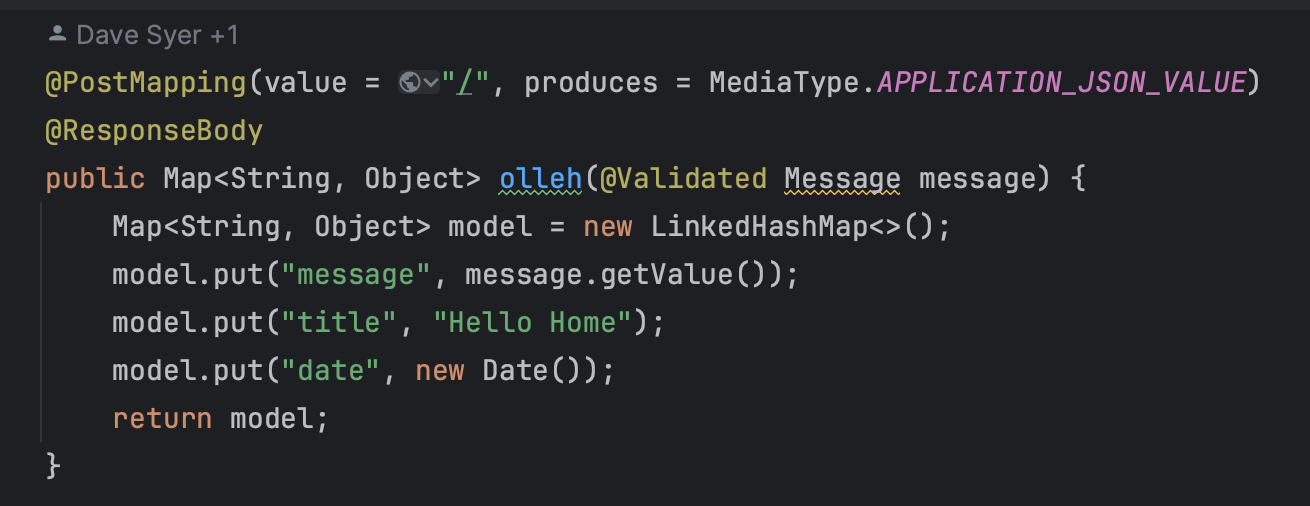
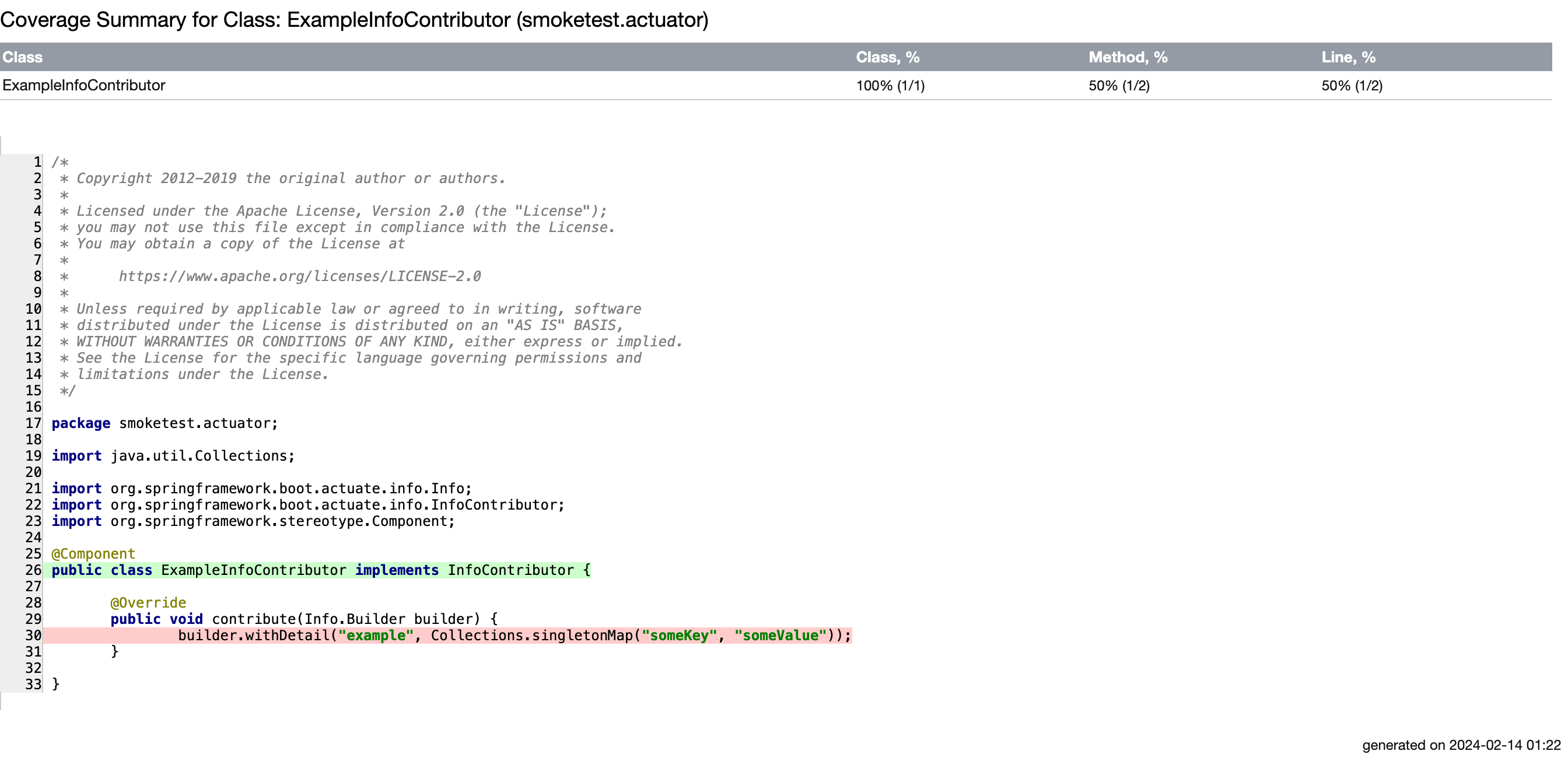
Both method are relatively simple, the first one handles HTTP POST requests to the root URL ("/") and return some kinds of map info such as current date etc., and the second one is mapping a KV pair into the end of actuator info.
Challenges Encountered
Our initial attempts to cover the first target with test cases resulted in multiple failures. Specifically, we encountered a 401 Unauthorized status instead of the expected 200 OK. Upon reviewing the debug logs, we discovered that Spring Security’s CSRF (Cross-site request forgery) protection was blocking the POST requests.
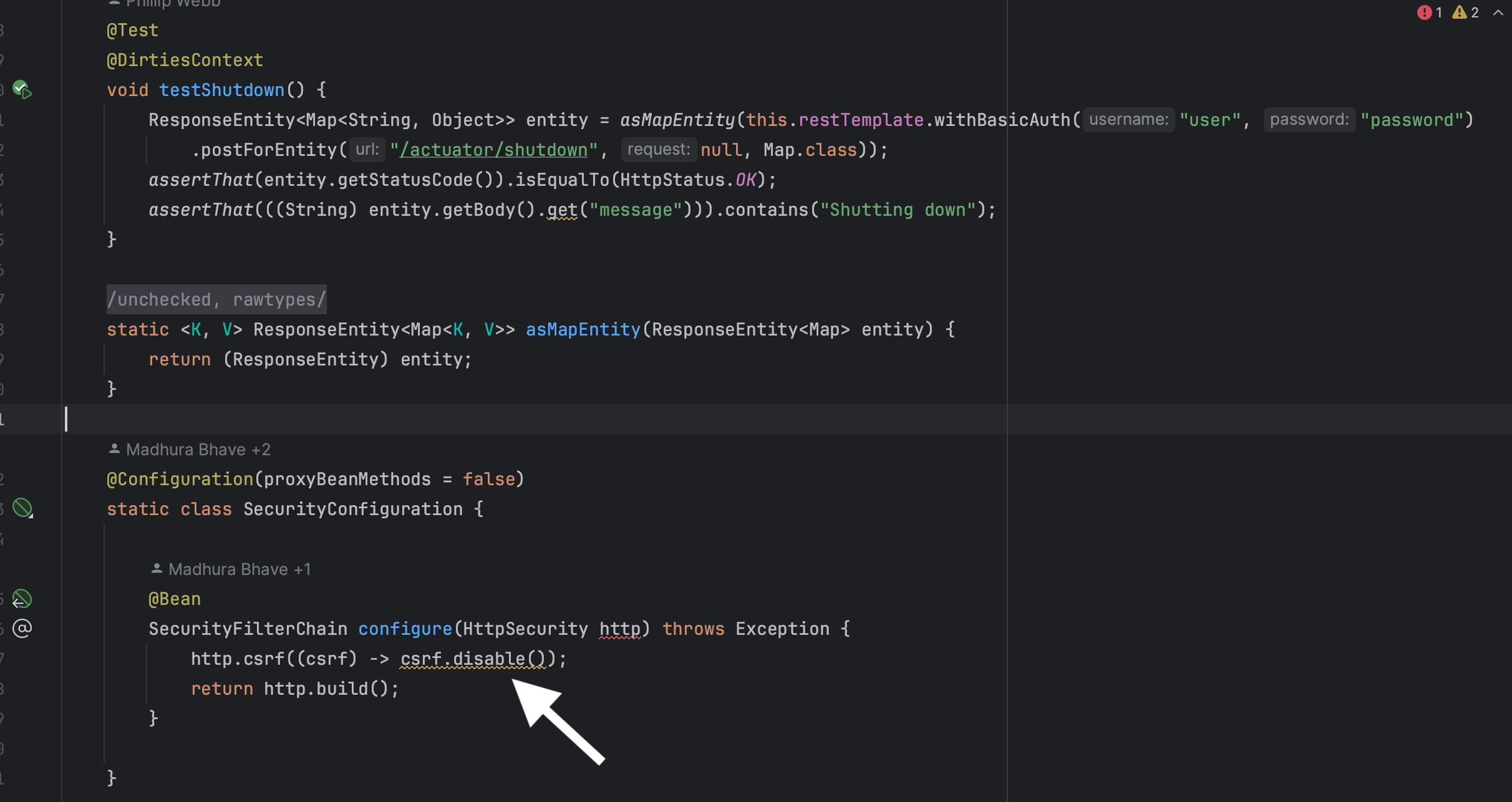
Despite disabling CSRF protection, our tests still returned a 404 status, indicating further complications possibly related to requiring a valid token or additional configuration adjustments.
Given the complexity of Spring Security and our limited experience with it, we decided to redirect our efforts towards other methods for coverage improvement. Spring Security’s comprehensive nature suggested that a deeper dive into its configuration and security mechanisms would be necessary for successful method coverage in areas protected by security policies.
We turn our attention to the second method. It seems like this code is brief, but in fact it does a lot of things under the hood. You may notice that the method itself introduce a new Builder class. See the below picture to take a look at this class itself.
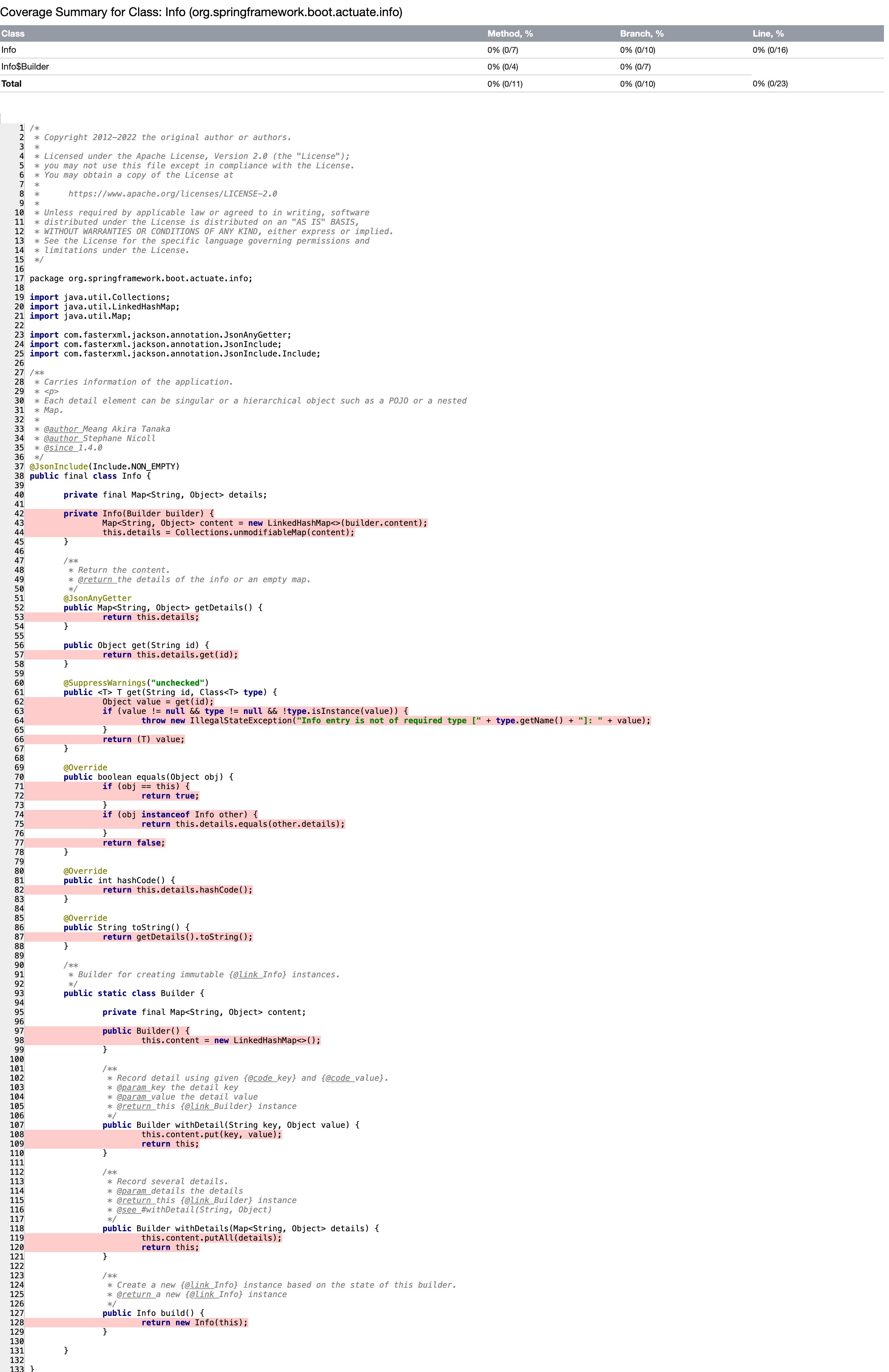
Let’s analyze what this code does specifically from the source code perspective.
Interface Implementation: It overrides the
InfoContributorinterface’scontributemethod. Implementing this interface enables the addition of custom information to the Actuator’s /info endpoint through the introduction of aBuilderclass.Detail Addition: Utilizes the
Builderclass’s withDetail method to add a key-value pair (example key with a map object {someKey, someValue}) as custom information.HashMap Initialization and Construction: The Builder initializes and constructs a new HashMap, incorporating existing info content. This step ensures that any previously available information is retained and integrated with the new details.
Info Map Construction: It calls the withDetail method again to incorporate the custom information into the new HashMap, effectively building the enriched info map.
Info Map Retrieval: Upon request to the /info endpoint, the method returns the newly constructed info map, now containing both existing and newly added details.
Test case
The test case aims to verify the functionality of the override contribute method within the Spring Boot Actuator’s info endpoint. It focuses on ensuring that:
- The HTTP connection is successfully established.
- The info endpoint is correctly configured and returns the expected build key.
- The contribute method functions as intended, allowing for custom information to be added to the endpoint.
@Test
	@SuppressWarnings("unchecked")
	void testInfo() {
		ResponseEntity<Map<String, Object>> entity = asMapEntity(
				this.restTemplate.withBasicAuth("user", "password").getForEntity("/actuator/info", Map.class));
		assertThat(entity.getStatusCode()).isEqualTo(HttpStatus.OK);
		assertThat(entity.getBody()).containsKey("build");
		Map<String, Object> body = entity.getBody();
		Map<String, Object> example = (Map<String, Object>) body.get("example");
		assertThat(example).containsEntry("someKey", "someValue");
	}
Assertions
- HTTP Status Check: Validates that the HTTP connection to the
infoendpoint is established, indicated by anHttpStatus.OKresponse. buildKey Existence: Confirms that the info endpoint is functioning correctly by checking for the presence of thebuildkey, a critical component of the endpoint’s response.contributeMethod Functionality: Verifies that thecontributemethod properly adds custom information (“someKey”: “someValue”) to the endpoint’s response.
These are the coverage output after this tested case added. You can clearly see the changes in coverage methods, lines and branches.
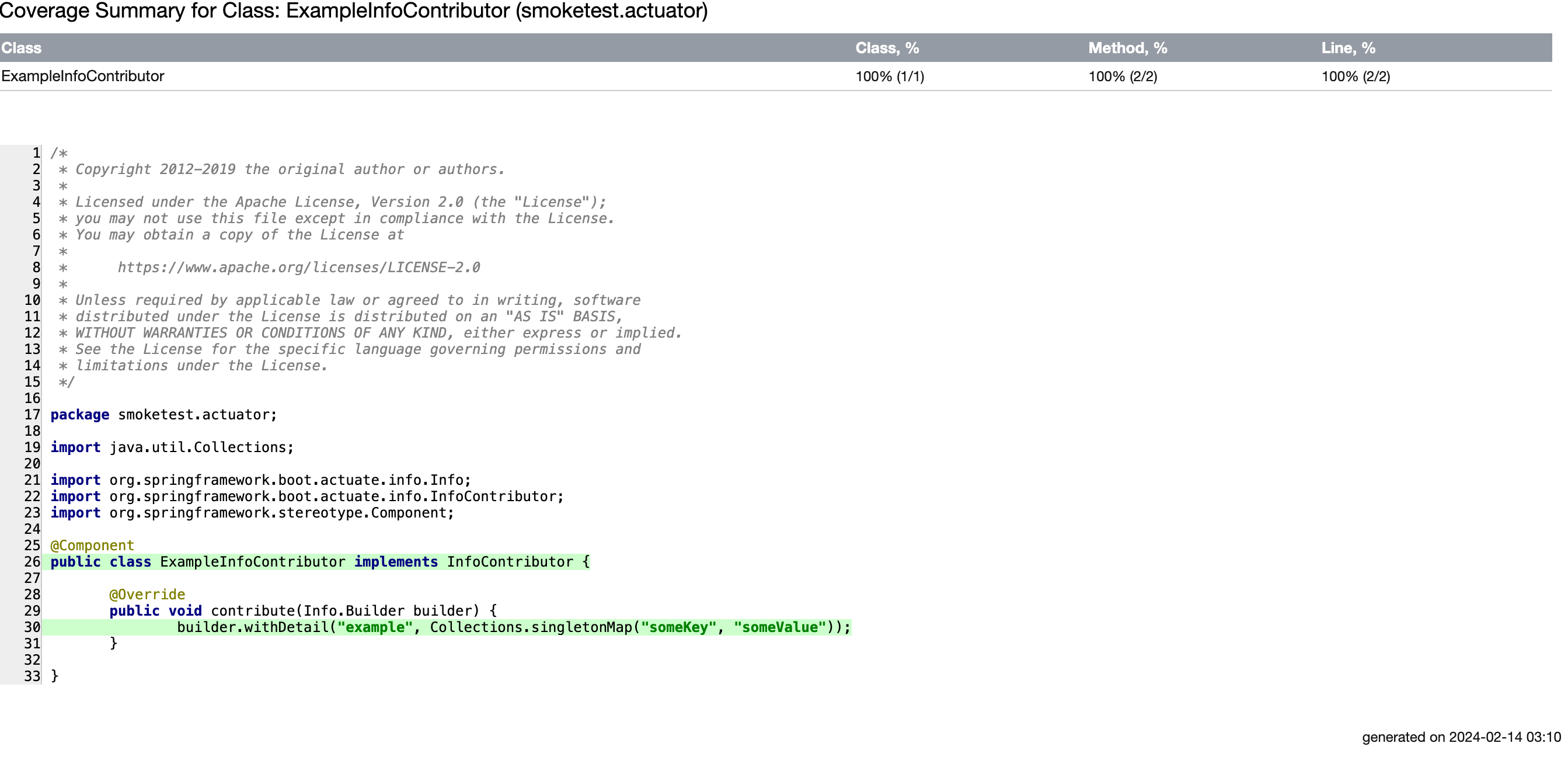
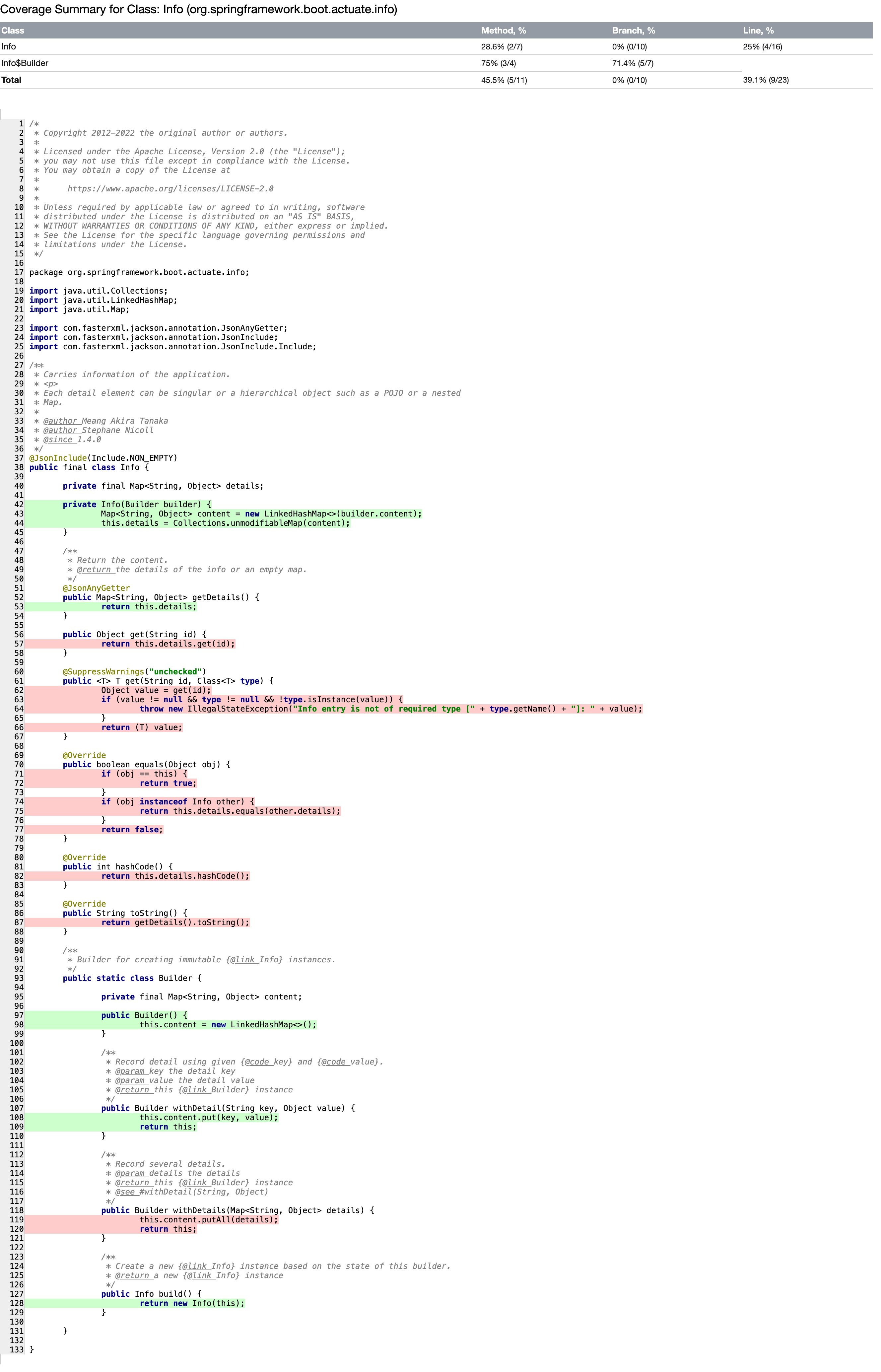
After incorporating this test case, the coverage metrics showed significant improvements in methods, lines, and branches within the tested class. However, to further enhance coverage, especially for untested branches and methods in the info class, additional tests could be considered. These might include:
- Testing the equal method with various expected outcomes.
- Calling the get method with both valid and invalid types.
Such tests would delve deeper into the framework’s internal functionality rather than focusing solely on the actuator smoke test system.
Conclusion
This test case effectively enhances the test coverage of the Spring Boot Actuator’s info endpoint, particularly focusing on the contribute method’s functionality. For comprehensive coverage, further tests exploring additional branches and methods within the info class are recommended.